Avoid "cheapskate feeds." There are a lot of cheapskates
out there who don't care about quality. Most mills have a line of
cheapskate feeds that you need to avoid, because they're bulked out
with fillers like wheat-milling byproducts that have little
nutritional value. Cheapskate feeds often have keywords telling you
what they are; words like "Country," "Thrifty," and so on. You'll
save money if you quality feed. < L1>Buy from
the best. Ask your practical-minded acquaintances who the best
feed mill is. Usually the verdict is almost unanimous. Buy from the
best feed mill: it always saves you money.
Use the "grain-on-the-side" method described further down
in this FAQ.
Minimize feed waste. Most feeders on the market are too
shallow, and the chickens throw feed in all directions. In some
tube feeders, it pours over the side on its own. Losing 10% of your
feed in this way is very common! Find the deepest feeders you can
get your hands on, or make them yourself. Never fill trough feeders
more than 1/3 full. Spend more time watching your flock. If you
slow down, you'll notice things and everything will magically
improve, including the bottom line.
Get a book about poultry nutrition. A lot of what you'll
read on the Internet or hear from your neighbors will be nonsense,
and you'll want to immunize yourself. Also, it helps to have a
complete reference manual handy! The best poultry nutrition book in
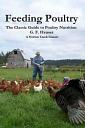
print is the one I reprinted myself, Feeding
Poultry by G. F. Heuser. There are other excellent books on the
topic, but they are all out of print. (I can't figure that out.)
2. Do I have to feed free-range chickens, or can they find their
own feed?
Chickens can find their own feed, but each chicken needs a lot of room
if this is going to work. Chickens can't find feed that isn't there,
and the more chickens you have, the less feed there is to go
around. You have to match the number chickens to the feed supply,
or nature will do it for you through poor health and starvation. How
it was done in the old days. A farmer of 100 years ago might have
kept a dozen hens and a rooster through the winter, and allowed the
hens to hatch a brood of chicks each in the spring, giving, say, 72
chicks plus the original 13 chickens, or 85 birds total. The old
rooster would be sold after the chicks had hatched. The old hens and
most of the young chickens would be sold in the fall, and one cockerel
and twelve pullets would be kept through the lean months. By having 85
chickens during the fat months and only 13 during the winter, the
amount of supplemental feed needed by the chickens would be minimized.
The old ways always involved malnutrition. A flock of 13
chickens might survive all winter on the grain spilled by a cow and a
team of draft horses, plus some hay and whatever else they could find.
This winter diet would be nutritionally poor (both vitamin- and
protein-deficient) and the hens would lay no eggs, but they'd recover
in early spring and the cycle would repeat.
Malnutrition increases with the number of chickens. I've
heard estimates that you can support 1-2 hens per acre with no
supplemental feeding, though probably not during the winter. As you add
chickens to the farm, they first exhaust the supply of high-calorie
feeds such as seeds, then the supply of high-protein feeds such as bugs
and clover. Finally, they use up the supply of high-vitamin feeds such
as green grass. Except for the last stages, when all the green plants
disappear, you can't tell what stage your forage is in.
In the bad old days, when people didn't feed their hens at all, much
of the hen's diet was provided as a side effect of poor sanitation.
People threw their garbage out into the street or the barnyard. The
cows and horses spilled grain. Manure was everywhere and was full of
yummy maggots. Even with all the natural bounty provided by stone-age
sanitation, the number of hens that could be supported without
supplemental feeding was very limited. Flocks of over fifty hens were
unusual before chicken feed was invented.
In practice, though, it always pays to provide a complete
diet. The increased production always pays for the increased feed
bill.
There are a few circumstances where the diet can be adjusted to
reflect reliable forage ingredients, such as old-fashioned "range
rations" which left out the vitamins that were provided in abundance by
green feed. But enough dry days in a row browns off the grass and makes
it unpalatable to the chickens, so this method has its risks. Also,
many of the things hens eat are so tiny that we can't see them -- tiny
seeds, tiny bugs, tiny worms. If we can't see them, we can't estimate
how much the hens are finding, and we can't know how much supplemental
feed they need on a day-by-day basis.
Fortunately for the frugal farmer, hens prefer fresh, natural feeds
to dry, processed chicken feed, and will eat natural feeds in
preference to store-bought feed whenever they have the chance. This
leads to a foolproof strategy:
Offer the chickens as much (balanced, high-quality) chicken feed
as they want, and settle for whatever amount of foraging they discover
on their own. This will maximize production and profitability.
Sure, if you're an expert and are always very careful, you can get
some eggs out of a flock you don't feed at all, without actually
crippling your chickens through malnutrition, but you won't get very
many. It's a mug's game.
Chicken feed. People like to complicate the feeding problem beyond all
reason. Go down to the feed store and buy a sack of feed that's labeled
for the kind of chickens you have (chick starter, broiler starter,
layer feed, etc.). This will be a balanced feed, and the chickens will
do fine if you don't feed them anything else.
You can also set out whole grains in a separate feeder if you like.
I do. This can save you a lot of money if you have a source of cheap
grain, especially if you use a high-protein chicken feed. For example,
a high-protein layer ration with 20% protein will be formulated for use
with supplemental grain, with the assumption that the hens will eat
about 50% layer ration and 50% grain. Chicks need lots of protein and
will pretty much ignore supplemental grain until they're older and
aren't growing as fast. There's really little point in offering them
grain until they're 6-8 weeks old.
If you want to try something fancier, I recommend that you get a
copy of Feeding
Poultry by G. F. Heuser.
4. Won't Commercial Chicken Feed Poison My Chickens?
Ah, Seventies hippie-dippy fear-mongering! We just don't get conspiracy
theories like that anymore. ("Everyone is a poisoner except me," said
the organic farmer.)
In the real world, of course, feed stores are totally dependent on
repeat business, of course. If your chicken raising is unsuccessful,
you won't raise any more chickens, and they can't sell you any more
feed. So, presumably, any feed store that has been in business for more
than the blink of an eye is selling feed that gets the job done.
An exception, as previously mentioned, is cheapskate feeds.
Cheapskates insist on buying the very worst feed available, and there
are enough of them that most mills have a special line of feeds just
for them, which you need to avoid. Not that cheapskate feeds are
poisonous. They're just crummy.
I have never had any trouble with commercial feed. In general, you
should ask around and see which feed store is considered to be the most
reputable by your neighbors, and buy from them. Local reputation is
rarely wrong.
Read the feed tag to see what's in the chicken feed. I also taste
chicken feed sometimes to see if it has any off flavors. It shouldn't
have any kind of burned or rancid taste, which would indicate the use
of bad ingredients. But every time I've tested, it's just been
incredibly bland, not distateful at all. It's so bland, you could
probably sell it as a health-food cereal.
5. Isn't Chicken Feed Full of Medications?
Medicated feed says "MEDICATED" in large letters on the feed tag
(in the U.S., anyway). The only medication I've ever seen in feed-store
chicken feed is a coccidiostat in medicated chick and turkey starter
feeds, which keeps the chicks from coming down with coccidiosis. You
should have no trouble getting non-medicated feeds if that's what you
want.
I recommend that beginners start with medicated chick starter,
because an outbreak of coccidiosis is very discouraging. Sick and dying
chicks do not make for the kind of farming experience you would care to
repeat, so do yourself a favor. When you're more experienced and you
feel your management is pretty good, try the non-medicated starter.
6. Aren't Chicken Feeds Full of Hormones?
That's ancient history. We're talking about the Truman and Eisenhower
years here. Hormones in poultry feed are illegal these days. Hormones
had a brief burst of popularity in the late Forties and early Fifties.
By the time the once-popular hormone DES was banned in 1959, it had
fallen into disuse. Anyway, it wasn't used in the feed, but was in the
form of a little time-release pellet that was injected under the skin.
7. What do You Feed Your Chickens?
For my hens, I use the three-feeder system. I have one feeder full of
20% protein layer pellets, one feeder full of whatever whole grain is
cheapest (usually corn), and one feeder full of oystershell.
The reason I do this is that chickens have a definite calcium
appetite (oystershells), energy appetite (grain), and protein appetite
(high-protein poultry ration). A hen who lays an egg a day will eat far
more calcium than one who lays an egg a week. If the only source of
calcium is the chicken feed, she will eat feed just for its calcium,
and get fat. With calcium offered on the side in the form of
oystershell, she can eat the calcium she wants without unwanted
calories. Similarly, a hen who is not laying at the moment wants little
calcium or protein, and will eat mostly grain, which is cheaper than
the other ingredients.
Furthermore, forage is high in protein. When the pasture plants are
bright green and succulent, or when there are lots of slow-moving bugs
and worms around, the hens get a lot of protein by foraging, turn up
their noses at the pellets, and eat mostly forage and whole grain. When
the pasture plants turn brown and the insects move too fast, they fall
back on the pellets. Since pellets are more expensive than grain. I
win.
Research is inconclusive about the value of this method when
all the ingredients are bought at commodity prices. However,
most people buy by the sack or by the ton. If you find your local grain
wholesaler or a local farmer with a full granary, you can buy grain at
wholesale prices and pellets at retail, which will bring you big
savings. We buy our grain at Venell Feed in Corvallis Oregon,
and broiler/layer feed from Union
Point Custom Feeds in Brownsville, Oregon.
For pullet chicks, I feed chick starter for several weeks, then
offer grain in a separate feeder. Once the chicks go onto pasture, they
get the same ration as the hens.
Broiler chicks start with a 22% broiler starter, graduate to the 20%
broiler grower ration from Union Point, which is later supplemented
with whole grains.
Turkeys are similar to broilers: start with a 28% turkey starter,
graduate to a 20% broiler grower, which is later supplemented with
whole grains.
All my poultry also have access to range.
8. What About Animal Byproducts in the Feed?
I don't use poultry feeds that contain animal poultry byproducts
such as beef scrap. I don't have anything against beef scrap in
general, but when I had goats, they would sometimes get into the
chicken feed. Since one of the cornerstones of BSE prevention is to
prevent ruminants from eating meat byproducts of other ruminants, so I
avoid feeds with beef scrap for that reason.
9. Should I Mix My Own Feed?
If that's what you want. I don't. Poultry nutrition is an interesting
topic and makes a good hobby, though I find the theory to be more
useful than the practice: I'd rather pay a good feed mill to do the
formulation and mixing for me, though I'm glad I've read several
poultry nutrition books, so I understand what it is that I'm delegating.
You should read a book on poultry nutrition first. The best one is
Feeding Poultry: The Classic Guide to
Poultry Nutrition by G.F. Heuser. It's so good that I brought it
back into print myself, under my Norton Creek Press label. It covers
all sorts of topics that are neglected in more recent poultry nutrition
books, such as the nutritional value of free range. At the same time,
it's recent enough that all the major nutrients and topics get a full
treatment. I like this book because it is written for the intelligent
layman rather than an audience of professional scientists.

 ogle Code for Remarketing Tag -->